


In the ever-evolving world of warehouse automation, pallet shuttle systems have become essential for optimizing storage, improving retrieval speeds, and reducing labor costs. As technology matures, shuttle systems have evolved from basic semi-automated setups to advanced free-roaming solutions, each offering unique benefits depending on operational needs.
In this blog, we’ll break down the three primary types of pallet shuttle systems,1D, 2D, and free-roaming, and explore how the Moffett Taxi, our flagship free-roaming pallet shuttle, is leading the way in high-performance warehouse automation.
1D Semi-Automated Pallet Shuttle: Entry-Level Automation
The 1D pallet shuttle is the entry point into warehouse automation. It moves pallets horizontally within racking systems and is typically used alongside forklifts.
Key Features of 1D Systems:
- Horizontal Movement Only: Operates along a single axis within a storage lane.
- Manual Integration: Requires forklift operators to load/unload and reposition the shuttle.
- Simple Efficiency Boost: Ideal for facilities aiming to reduce forklift travel in dense racking environments.
While still dependent on human interaction, 1D systems deliver efficiency gains in high-density storage applications, especially for businesses taking their first steps into automation.
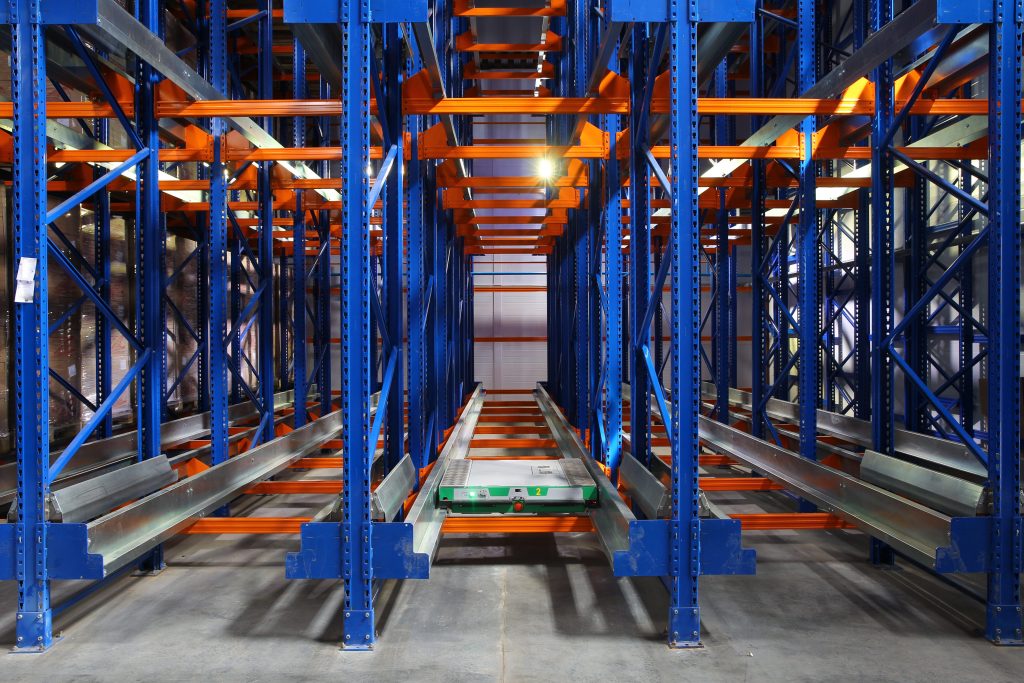
2D Fully Automated Pallet Shuttle: Smarter Space Utilization
Taking a significant step forward, 2D pallet shuttle systems can autonomously move pallets into multiple lanes within their assigned level in the rack structure.
Core Advantages of 2D Shuttles :
- Bidirectional Movement: Can move forward, back, left and right.
- Higher Storage Density: Increases storage efficiency by navigating to various rack positions.
- Integrated Control Systems: Typically paired with warehouse management software for intelligent, automated operation.
2D shuttles are ideal for operations needing greater flexibility, reduced human involvement, and improved throughput without a full overhaul of existing infrastructure.
Free-Roaming Pallet Shuttle: The Future of Warehouse Automation
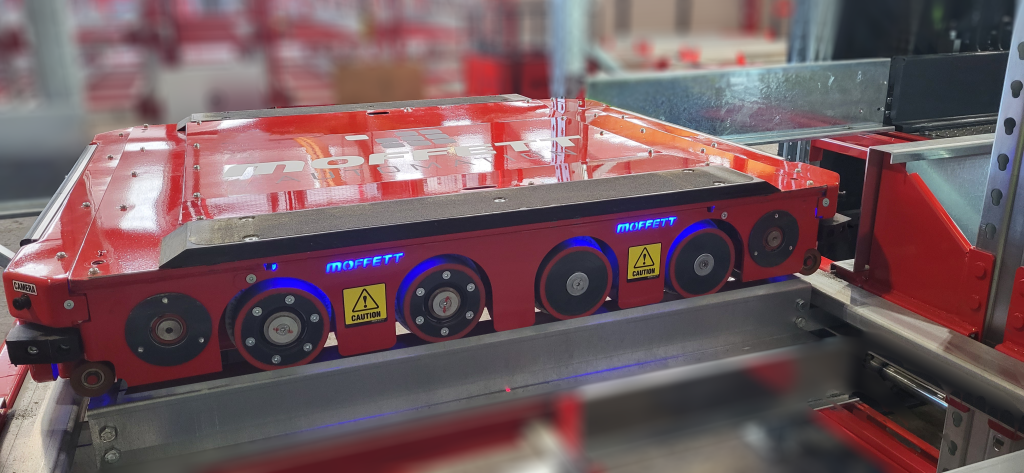
At the cutting edge of automation, free-roaming pallet shuttles remove the physical constraints of traditional guided systems. The Moffett Taxi is a prime example of this next-gen technology—engineered to move freely across all dimensions within a warehouse environment.
Why Choose a Free-Roaming Shuttle:
- Unrestricted Movement: Operates across horizontal, vertical, and depth planes with no fixed tracks or predefined paths.
- Maximum Flexibility: Capable of navigating dynamic environments, making it ideal for rapidly changing SKUs and storage layouts.
- Full Automation: Seamlessly integrates with WMS and WCS software, eliminating the need for manual handling or forklift support.
- High Throughput: Built for scale, speed, and precision in large, high-demand distribution centers.
The Moffett Taxi stands out by offering full spatial freedom, enabling warehouses to adapt faster, store more efficiently, and scale effortlessly as business demands grow.
Choosing the Right System
The right pallet shuttle solution depends on the complexity, volume, and flexibility your warehouse requires:
- 1D systems offer a simple, cost-effective boost to throughput with minimal automation.
- 2D systems provide more automation and smarter space utilization.
- Free-roaming systems like the Moffett Taxi offer the ultimate in flexibility, scalability, and performance.
No matter where your operation sits on the automation journey, understanding these distinctions can help guide smarter investment decisions. Whether you’re retrofitting an existing facility or building from the ground up, selecting the right pallet shuttle system is key to unlocking greater efficiency and long-term ROI.
FAQ
Unlike fixed-track systems, the Moffett Taxi is completely free-roaming. It navigates in all three dimensions – horizontal, vertical and depth. This delivers:
-
Maximum flexibility for changing SKUs and layouts
-
Seamless WMS/WCS integration for full automation
-
High throughput via dynamic path-planning and obstacle avoidance
-
Scalability without the cost or downtime of adding new track infrastructure
Savings vary by system type, facility size and throughput, but operators generally observe:
-
1D Semi-Automated Shuttles: 10–30 percent reduction in forklift travel time, equating to roughly 5–15 percent labour-cost savings in the first year.
-
2D Fully Automated Shuttles: Further cuts in manual handling deliver 20–40 percent less forklift movement, driving 15–25 percent in direct labour-cost savings.
-
Free-Roaming Systems (e.g. the Moffett Taxi): Complete elimination of dedicated forklift shuttle runs, enabling up to 30–40 percent reduction in overall warehouse labour requirements—and in some configurations, nearly 100 percent autonomous pallet handling within the racking area.
Actual results will depend on pallet volumes, rack density and integration with your WMS/WCS.
Payback periods can range from 12 to 24 months, depending on system complexity and throughput:
-
1D Semi-Automated Shuttles often deliver ROI within 12–18 months thanks to immediate reductions in forklift idle time and faster stock rotation.
-
2D Fully Automated Shuttles typically reach payback in 15–20 months as they boost storage density and further cut labour costs.
-
Free-Roaming Systems like the Moffett Taxi may see ROI in 18–24 months, reflecting higher upfront investment but offering dramatic gains in flexibility, throughput and long-term operational savings.
